The Anatomy of a High-Converting X DM: A Data Analysis of 10,000+ Outbound Messages
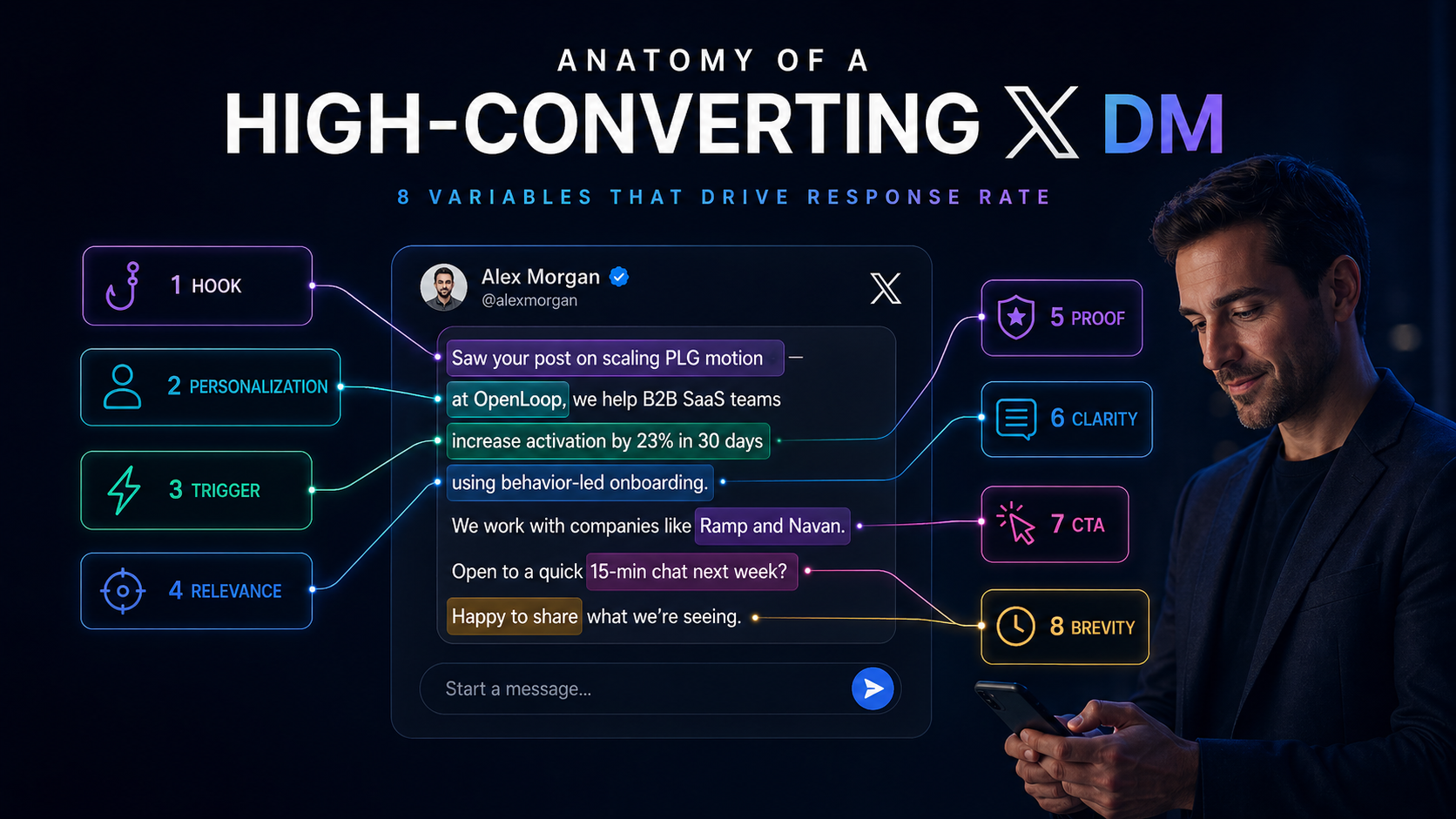
The difference between an X DM that gets a reply and one that disappears isn't talent. It's structure. After analyzing patterns across 10,000+ B2B outbound DMs sent through compliant, signal-based workflows on X — alongside the broader 2026 outbound benchmark data from Instantly, Hunter.io, Sopro, Apollo, and others — the same eight variables show up again and again as the difference between a 4% response rate and a 25%+ response rate. None of them are secret. Most teams just don't measure them.
This piece breaks down what the X DM response rate data actually says about message length, opening lines, personalization depth, send timing, follow-up cadence, and the structural choices that compound into reply-rate gains. By the end, you'll have a clear, data-backed framework for diagnosing why your DMs aren't converting — and what to change first.
TL;DR — The 8 Variables That Drive X DM Response Rates
Message length:
50–125 words is the sweet spot. DMs over 150 words drop to 8–15% response rates; under 50 words can hit 30–40% on warm audiences.
Opening line:
Specific observation > pleasantry. "Hope you're well" loses to "Saw your post about [specific thing]" by 2–3×.
Personalization depth:
Advanced personalization (beyond first name) lifts replies 4–7× over templates.
Signal-anchoring:
DMs tied to a real intent signal (a tweet, a complaint, a question) outperform generic outreach by 3–5×.
Single CTA:
Multiple asks dilute reply rates by ~30%. One specific, low-friction ask wins.
Tone:
65% of decision-makers say messages "too sales-focused" is the #1 reason they ignore cold outreach — surpassing irrelevance for the first time in 2026.
AI fingerprint:
69% of decision-makers report being bothered when a message feels AI-generated. Polish kills replies.
Follow-up:
Follow-ups generate 42% of all responses, yet 48% of senders never send a second message.
The compounding effect:
Teams that get 6 of the 8 right consistently hit 20–35% response rates on warm-signal DMs. Teams that get 2–3 right average 3–8%.
A Note on the Methodology
The patterns in this analysis are drawn from two sources: aggregate observations from compliant, signal-based DM workflows (where prospects were identified by their public X activity, then approached via human-approved DMs), and the broader 2026 cold outreach benchmark data from independent platform reports. Where a number applies specifically to X DMs, it's labeled as such. Where a number is drawn from broader cold-outreach research and applies because the underlying mechanics are the same (a human deciding whether to reply), it's labeled accordingly.
Two important caveats:
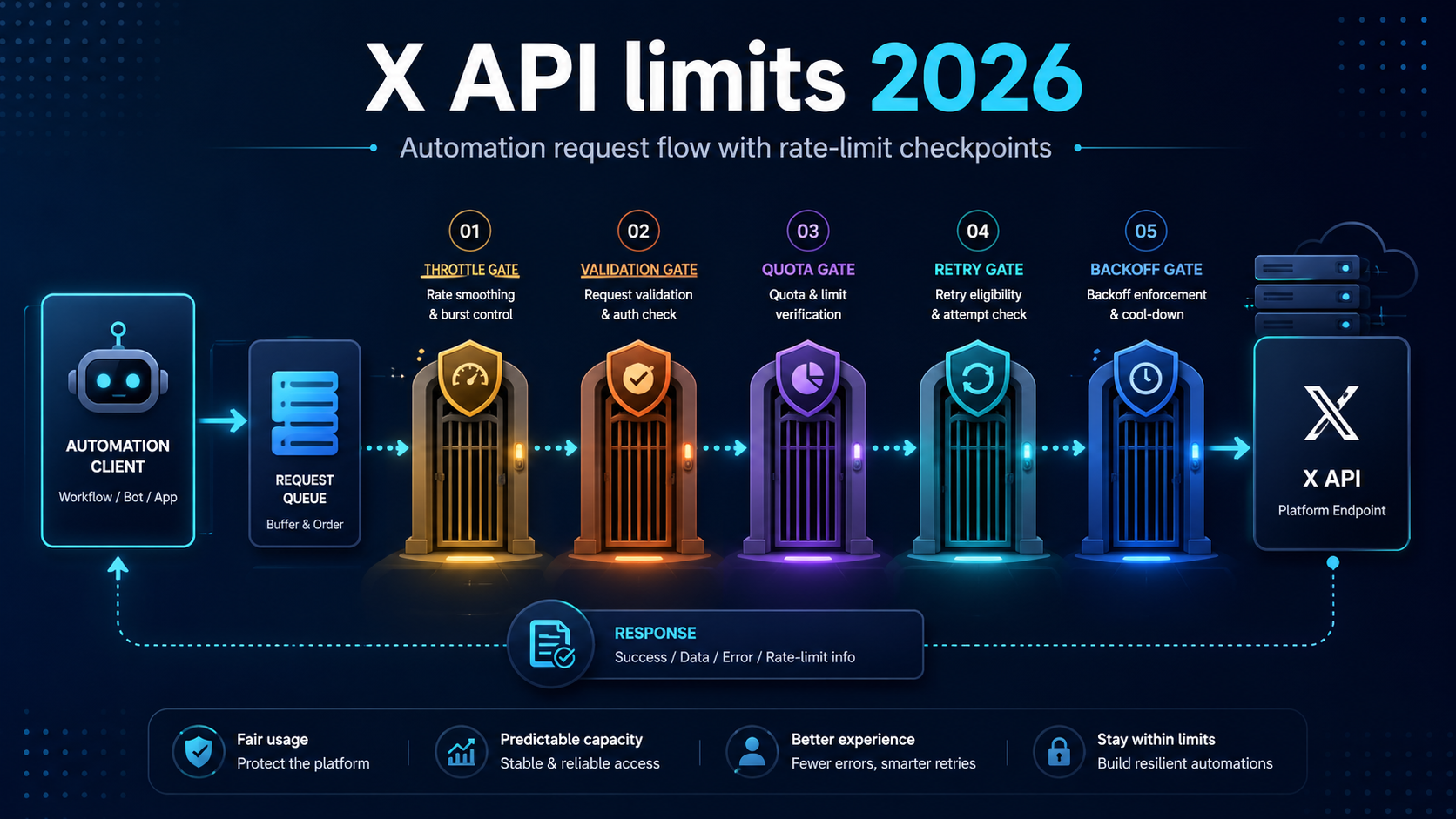
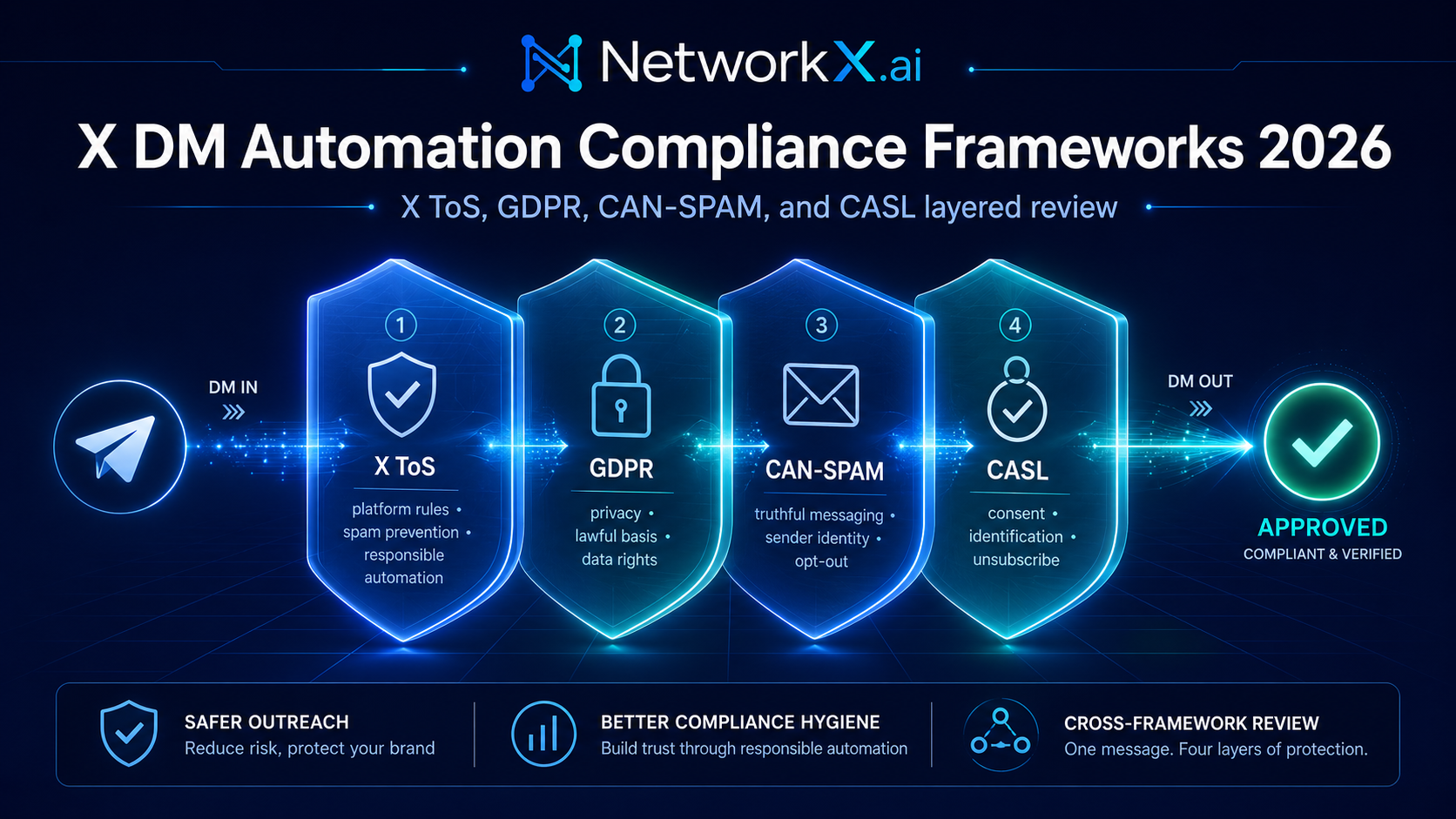
X explicitly prohibits programmatic cold DMs.
The data here reflects DMs sent through compliant, opt-in or signal-warmed workflows — not bulk-blast campaigns. (See
X API limits in 2026
for the rules.)
Response rates compound non-linearly.
Improving one variable lifts replies modestly. Improving four or five simultaneously can multiply replies 5–10×.
Variable 1: Message Length
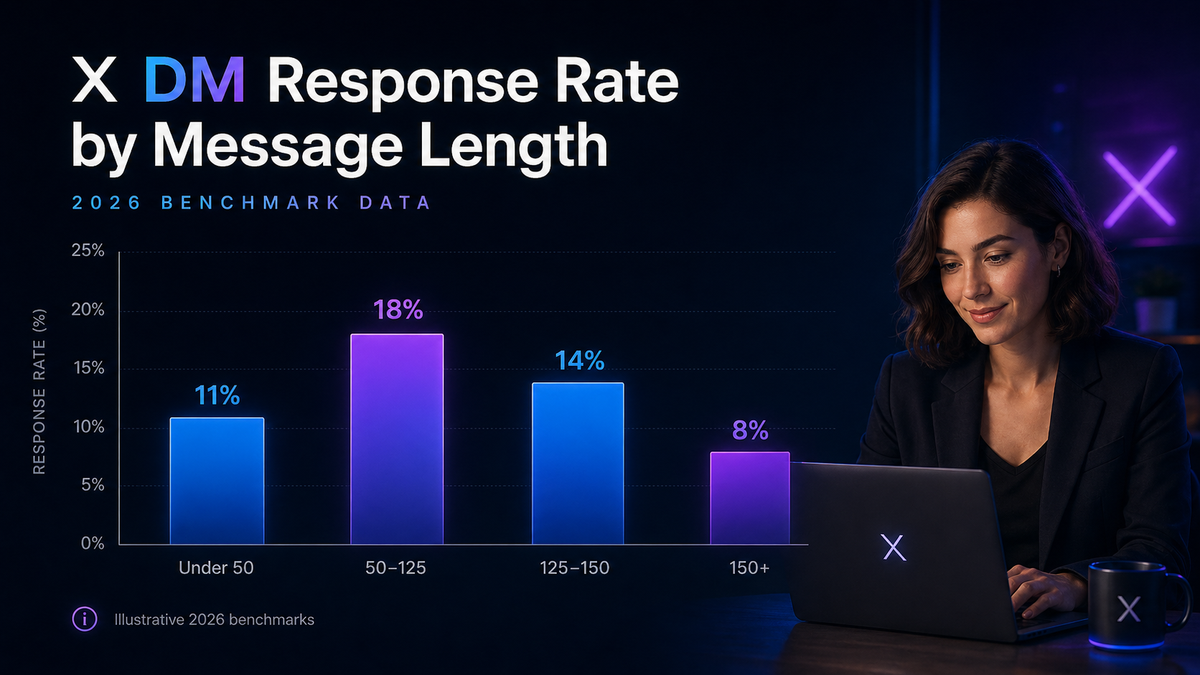
The single clearest pattern in the 2026 data is that shorter wins. Across multiple independent benchmarks:
- DMs under 50 words: 30–40% response rates on warm or signal-anchored audiences
- DMs 50–125 words: highest sustained reply rates across cold outreach generally — the long-running "sweet spot"
- DMs 150+ words: drop to 8–15% response rates
- First-touch outreach under 80 words with a single CTA: consistently outperforms longer first messages
The mechanism is simple. X DMs are read on mobile, often in a notification preview. A prospect decides in under three seconds whether to engage. Anything that doesn't fit on one screen reads as effort the recipient hasn't agreed to invest in.
The diagnostic test:
open your DM on a phone. If you have to scroll, it's too long.
What this looks like in practice
A 35-word DM that earns a reply:
Hey [Name] — saw your post about [specific challenge]. We've solved that exact problem for [similar company]. Worth a 10-min walkthrough? Either way, here's the one-pager: [link]
The pattern: specific reference, brief credibility marker, low-friction ask, optional resource if they say no. Total cognitive load on the recipient: minimal.
Variable 2: The Opening Line
The first sentence determines whether a DM gets read or swiped away. The 2026 data is unforgiving on this:
- Pleasantry openings ("Hope you're well," "Hope this finds you well," "Happy Tuesday") consistently underperform — they read as templated and signal "another sales pitch incoming"
- Specific observation openings that reference a real, recent piece of the prospect's public activity outperform pleasantries by 2–3×
- Insight openings that lead with a relevant data point or industry observation perform similarly well — but only when the insight is genuinely tied to the prospect's situation
Three opening types that work on X:
The specific observation:
"Saw your thread on [topic] yesterday — the point about [X] resonated." (Works because X is a public platform; referencing public activity is
expected
on X in a way it isn't on cold email.)
The shared context:
"Caught the announcement that [Company] just [milestone]. Congrats." (Time-sensitive, specific, hard to fake.)
The pointed question:
"Curious — when you mentioned [specific thing] last week, were you talking about [specific use case]?" (Reads as a real human paying attention, not a sales pitch.)
Three opening types that kill replies:
"Hope this message finds you well..." (templated, signals automation)
"I came across your profile..." (weak — every cold message comes from someone who came across the profile)
"I help companies like yours..." (about you, not them, in the first sentence)
Variable 3: Personalization Depth
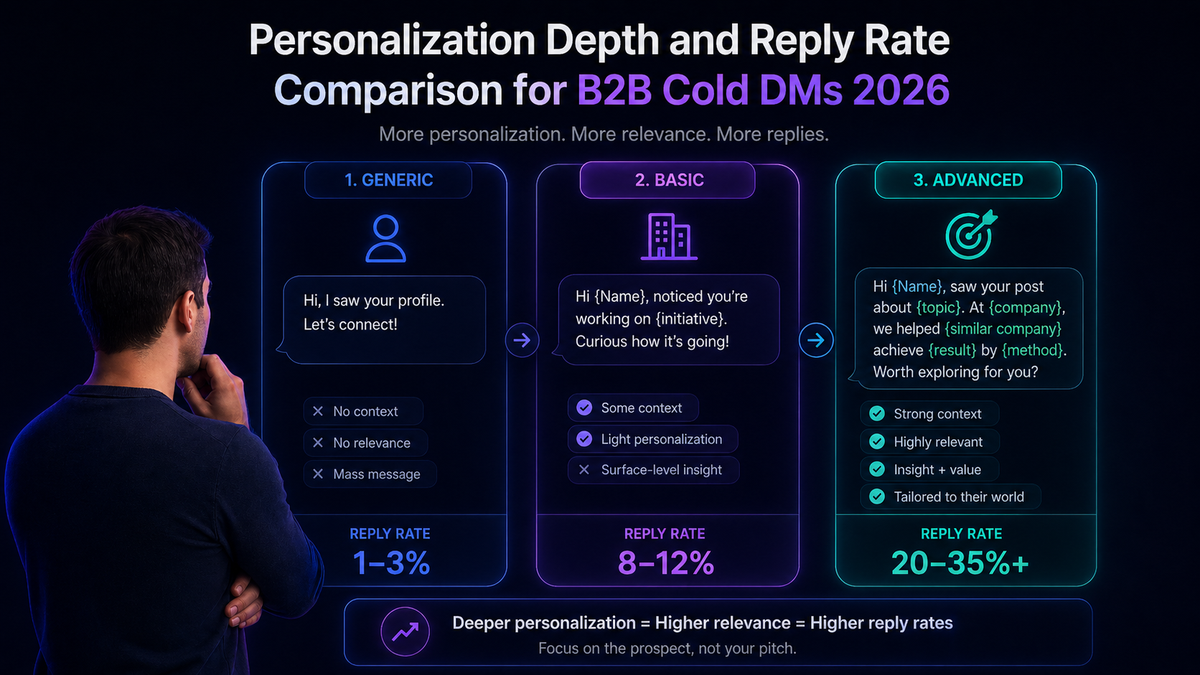
Personalization is not "Hi {first_name}." That's table stakes — and after a decade of templated outbound, every prospect's pattern-recognition for first-name-only messages is fully calibrated.
The 2026 data shows three distinct tiers:
| Personalization tier | Typical reply rate | What it includes |
|---|---|---|
| Generic / first-name only | 2–4% | "Hi Sarah, I help companies like yours..." |
| Basic variables | 4–8% | First name + company name + role |
| Advanced personalization | 8–18% (cold), 25%+ (warm) | First name + role + recent specific activity + tied-to-real-pain context |
The Hunter.io 2026 outreach study found that emails with two custom attributes saw +56% higher reply rates than non-personalized emails (5.6% vs. 3.6%), and that manually edited messages outperform fully automated ones by +18%. The same dynamics apply to DMs — possibly more strongly, because X audiences are more attuned to authenticity signals than email audiences.
The threshold question for any DM:
Could this message have been sent to anyone else?
If the answer is yes, it's not personalized — it's templated.
Variable 4: Signal-Anchoring (X's Structural Advantage)
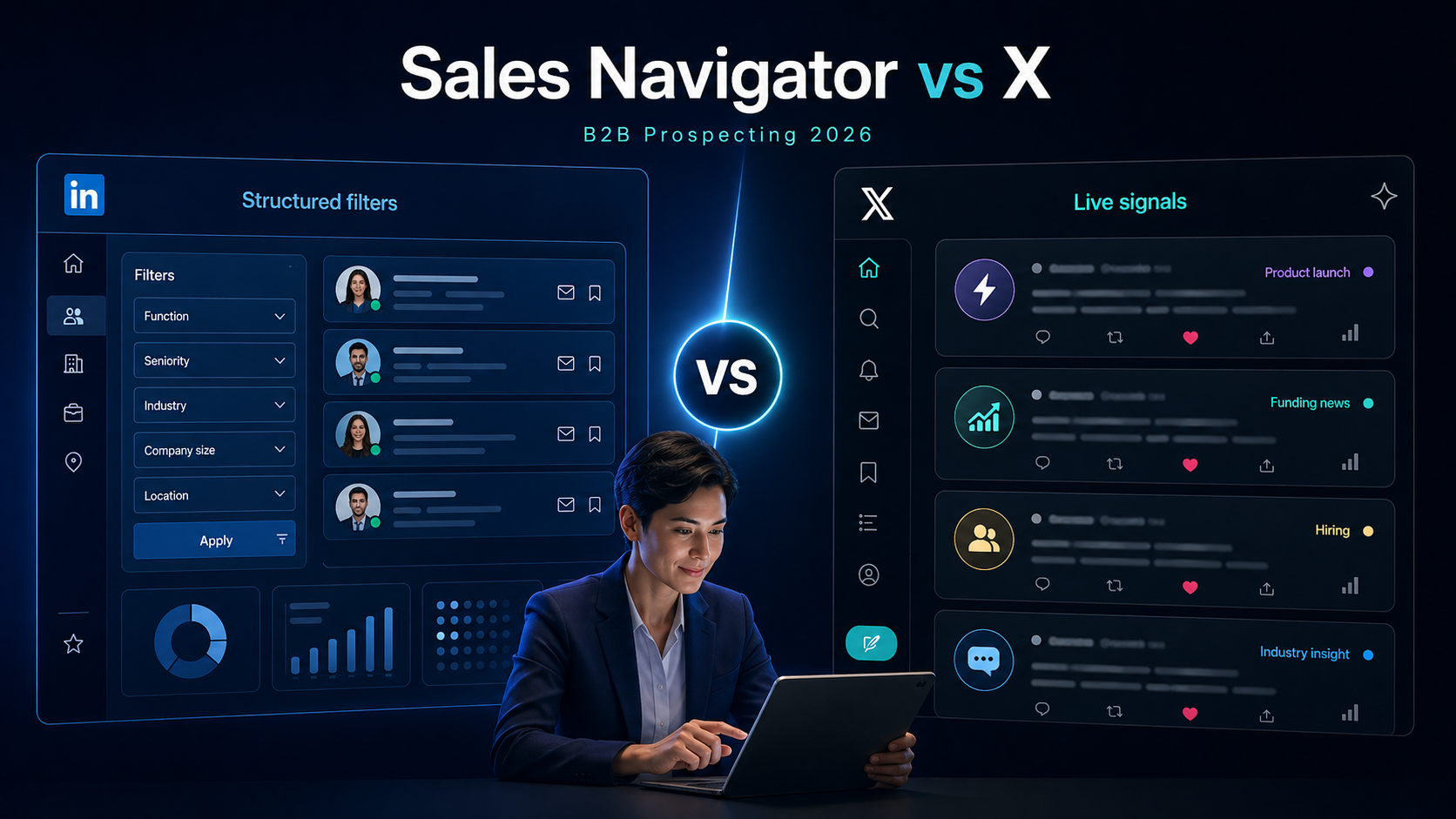
This is the variable where X has a real edge over email and even LinkedIn. Every X DM should be anchored to a public signal — something the prospect said, did, or engaged with that's visible to anyone.
Independent research from Salesmotion's 2026 outbound playbook found that "five minutes of account research before sending increases reply rates 3–5× compared to template-based outreach." On X, that research is sitting in the open: their last 10 tweets, what they replied to, what they bookmarked, who they engage with, what they complained about.
The high-converting DM pattern:
[Specific reference to a public signal] → [Brief context tying it to a relevant capability] → [Single, low-friction CTA]
Examples of strong signal anchors on X:
- A complaint about a competitor or current tool
- A question asked in public ("Anyone have a recommendation for…")
- A celebration (raise, launch, hire) you can credibly engage with
- A take or thread where you have something genuinely relevant to add
- An engagement pattern that suggests evaluation (following multiple competitors, retweeting analyses)
The asymmetry: prospects on X expect you to have read their public activity. The signal-anchored DM doesn't feel like surveillance — it feels like attention.
Variable 5: The CTA Problem
One of the most consistent findings across the 2026 outbound data: single-CTA messages outperform multi-CTA messages by ~30%.
Yet most DMs include 2–3 asks: "happy to chat / send a deck / share the case study / hop on a call." The intent is "make it easy to say yes," but the effect is decision fatigue. Every additional option dilutes the probability of any one being chosen.
What works in 2026 X DMs:
- One specific, low-friction ask
- The ask is calibrated to where the prospect actually is in their journey
- The ask is not "book a 30-min call" by default — Gartner's 2025 buyer research found that 61% of B2B buyers prefer a rep-free buying experience, which means leading with "book a call" misaligns with how most buyers want to engage
Higher-converting first-touch CTAs on X:
- "Worth a quick async DM exchange?" (lowest friction)
- "Want me to send the 1-pager?" (asset-led, no calendar)
- "If useful, I can show you how [specific company] solved this in 90 seconds — async screen recording" (specific, async, valuable)
Lower-converting first-touch CTAs:
- "Book 30 minutes here: [calendar link]" (high friction, presumptuous)
- "Are you the right person?" (qualifying as ask one is a tell)
- "Let me know if you'd like to chat / connect / hop on a call / explore further" (decision fatigue)
Variable 6: Tone — The 2026 Shift
The most important signal in the 2026 outbound data is a tone finding, not a copy finding.
For the first time, 65% of decision-makers cite "too sales-focused" as the #1 reason cold outreach fails — surpassing "lack of relevance" (61%) as the top complaint, per the Hunter.io 2026 State of Cold Email report. That's a meaningful inversion. The bar is no longer "be relevant." It's "don't read like a salesperson."
What this means structurally for X DMs:
- The first message should not pitch
- The first message should not include a deck, a calendar link, or a multi-paragraph value proposition
- The first message should sound like a human who happens to work somewhere, not a sales rep doing their job
Practical implications:
- Replace "I'd love to share how we can help [Company]..." with "Curious about your take on [specific thing] — the angle in your post struck me."
- Replace "We deliver X% improvement in Y..." with "We've seen [specific outcome] for [specific kind of team] — happy to share if relevant."
- Replace "Let's hop on a quick call to explore synergies..." with "If it's useful, I can send the one thing that'd actually be relevant."
The teams getting the highest response rates in 2026 sound like peers, not vendors.
Variable 7: The AI Fingerprint Problem
Closely related to the tone shift: 69% of decision-makers say it bothers them when a message reads as AI-generated, per the same Hunter.io 2026 study.
The "AI fingerprint" isn't about whether AI was used. It's about whether the message feels AI-polished. The telltale signs:
- Overly perfect grammar with no rhythm variation
- Generic, frictionless transitions ("Furthermore..." "Moreover..." "I hope this finds you well")
- Value propositions that could apply to any company
- Punctuation that's too clean (em-dashes everywhere, perfectly balanced commas)
- Structure that follows the textbook (hook → context → value → CTA) too obviously
The counterintuitive implication: on X specifically, slightly imperfect messages outperform perfectly polished ones. A small typo, a casual contraction, an incomplete sentence used for emphasis — these read as "human typed this on their phone" rather than "AI generated this and a human pasted it."
The diagnostic test:
read your DM out loud. If it sounds like something you'd write to a colleague, ship it. If it sounds like a press release, rewrite it.
Variable 8: Follow-Up Cadence
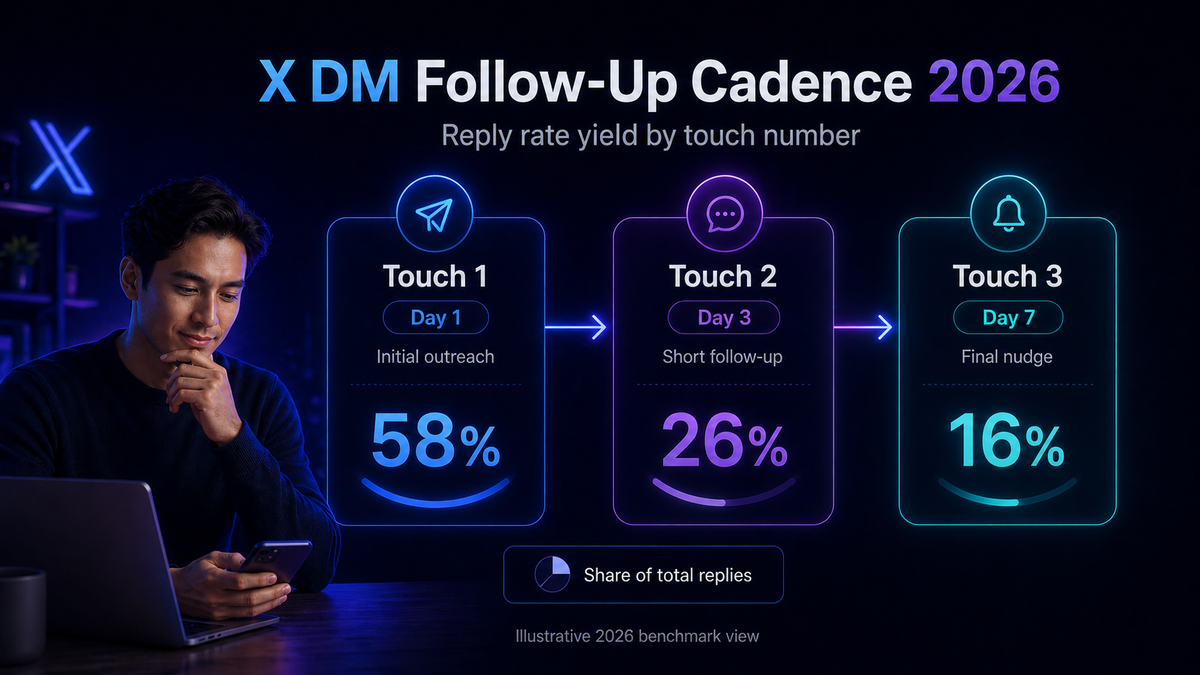
The single largest leak in B2B outbound is the missing follow-up.
The 2026 benchmark data is consistent across multiple sources:
- Follow-ups collectively generate ~42% of all replies (Martal, Belkins)
- 48% of senders never send a follow-up (same source)
- The first follow-up has the highest reply rate of any subsequent message — typically ~8.4%
- By the 5th follow-up, reply rate drops to ~3.8% and spam/unsubscribe risk triples
For X DMs specifically, the cadence that works in compliant workflows:
| Touch | Timing | Purpose |
|---|---|---|
| Touch 1 | Day 0 | Signal-anchored opening, single CTA |
| Touch 2 | Day 3–5 | Soft bump with new value (not "just following up") |
| Touch 3 | Day 10–14 | Relevant resource or different angle |
| Stop | After 3 touches | Diminishing returns + relationship preservation |
The "soft bump" Touch 2 outperforms the classic "just checking in" by a wide margin. Replace "just checking in" with: a relevant new piece of public context (their tweet, an industry development), a shorter version of the original ask, or a genuinely useful resource with no ask attached.
Putting It All Together: The High-Converting X DM Anatomy
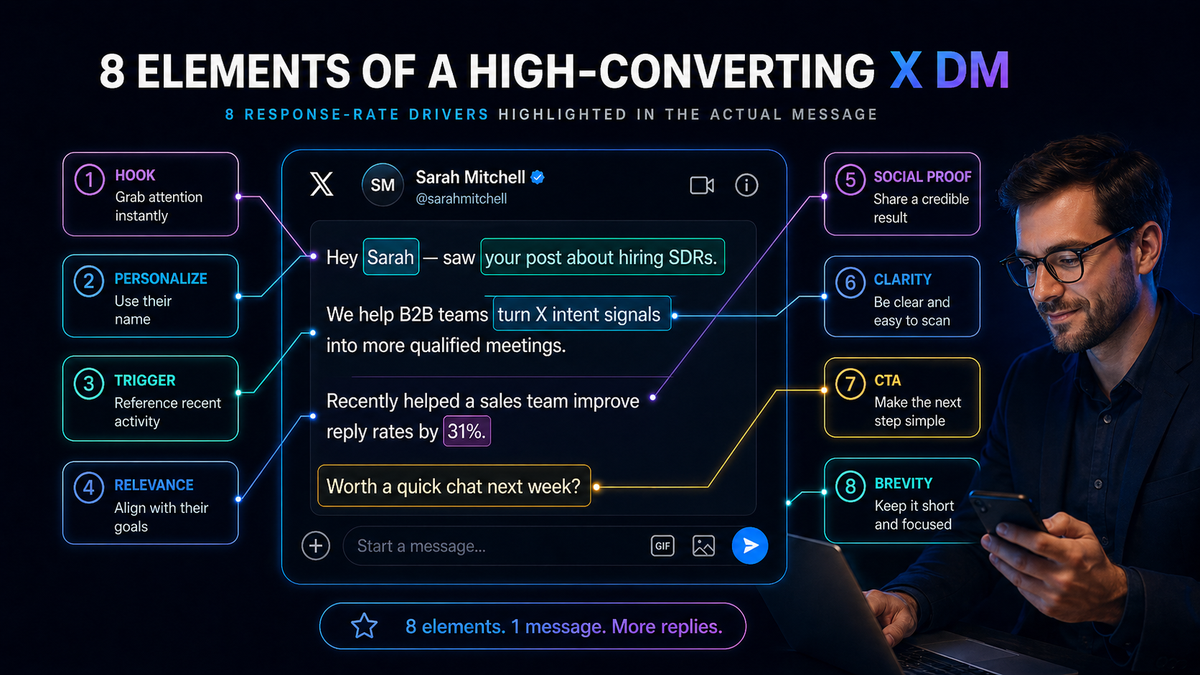
Here's the structural template that emerges from the data:
[OPENING: 1 specific reference to public signal, 10–15 words]
[CONTEXT: 1 sentence tying signal to relevant capability, 15–25 words]
[CTA: 1 specific, low-friction ask, 10–15 words]
[TOTAL: 50–80 words]
A worked example:
Saw your thread yesterday on the cost of LinkedIn outbound at scale — the math you ran on per-meeting cost matched what we've been seeing across other [Company-stage] teams. We've helped a few similar teams cut that cost ~60% by routing to X for top-of-funnel signal. Worth me sending the 90-second teardown of how that works?
Word count: 64. Single CTA. Signal-anchored. No pitch. Peer tone. Async option. Specific outcome.
This is the structural shape that the 2026 data converges on — not as a template to copy, but as the underlying architecture that the highest-converting DMs share.
How NetworkX.ai Operationalizes This
Most of the variables that drive X DM response rates require time the average outbound rep doesn't have. Reading a prospect's last 10 tweets, finding a relevant signal, drafting a personalized message, paced send, follow-up scheduling — done manually, this is 15–20 minutes per DM. At scale, the math doesn't work.
NetworkX.ai is built specifically for the variables in this analysis: it surfaces prospects expressing real-time intent on X, drafts signal-anchored messages tied to specific public activity, presents them for human approval (so the AI fingerprint stays low and X's compliance rules stay intact), and manages follow-up cadence inside platform-safe limits.
If you're looking to apply this anatomy to your own outbound, start a free trial — or if you want the full framework as a working playbook, download the X DM Anatomy benchmark report with templates, scorecards, and follow-up sequences.
Frequently Asked Questions
What is a good response rate for X DMs in 2026?
For warm, signal-anchored X DMs, 15–25% response rates are achievable and 30%+ marks elite performance. For cold DMs (which X explicitly prohibits programmatically), benchmarks aren't reliable because compliant cold outreach on X starts with a public engagement first. The general pattern: any DM tied to recent public activity from the recipient should clear 12% reply rate. Any DM under 8% reply rate has a structural problem in length, opening, or personalization.
How long should a cold DM on X be?
The 2026 sweet spot is 50–125 words for first contact, with under 80 words performing best on X specifically. DMs over 150 words drop to 8–15% response rates. The platform's mobile-first reading context means anything that doesn't fit in a notification preview reads as too much effort.
What's the best opening line for a cold X DM?
A specific reference to the recipient's recent public activity.
"Saw your thread on [topic]" outperforms "Hope you're well" by 2–3× in 2026 benchmarks. The structural reason: X is a public platform where referencing public activity reads as attention rather than surveillance. Avoid pleasantries, generic observations, or anything that could have been written to anyone else.
Are AI-written DMs less effective on X?
Polished, obviously-AI-generated messages underperform — 69% of B2B decision-makers report being bothered by AI-feeling outreach in the 2026 Hunter.io study. The issue isn't whether AI was involved; it's whether the message reads as human. AI-drafted DMs that go through human editing for tone, rhythm, and casual imperfection consistently outperform fully-automated ones by ~18%.
How many follow-ups should I send on X?
Three touches total
, spaced over 10–14 days. Follow-ups collectively generate ~42% of all replies, yet 48% of senders never send a second message. After the third touch, reply rates drop sharply and spam/unsubscribe risk triples. The first follow-up is the highest-yield message in the entire sequence.
What's the single biggest mistake in X DM outbound?
Sounding like a salesperson.
In 2026, "too sales-focused" surpassed "lack of relevance" as the #1 reason decision-makers ignore cold outreach (65% vs. 61%). This is a tone problem, not a copy problem — and it's solved by writing DMs that sound like a peer reaching out, not a vendor pitching. No pitch in message one. No calendar link in message one. No multi-paragraph value proposition in message one.