Sales Navigator vs. X for B2B Prospecting: Where Should You Spend Your Time in 2026?
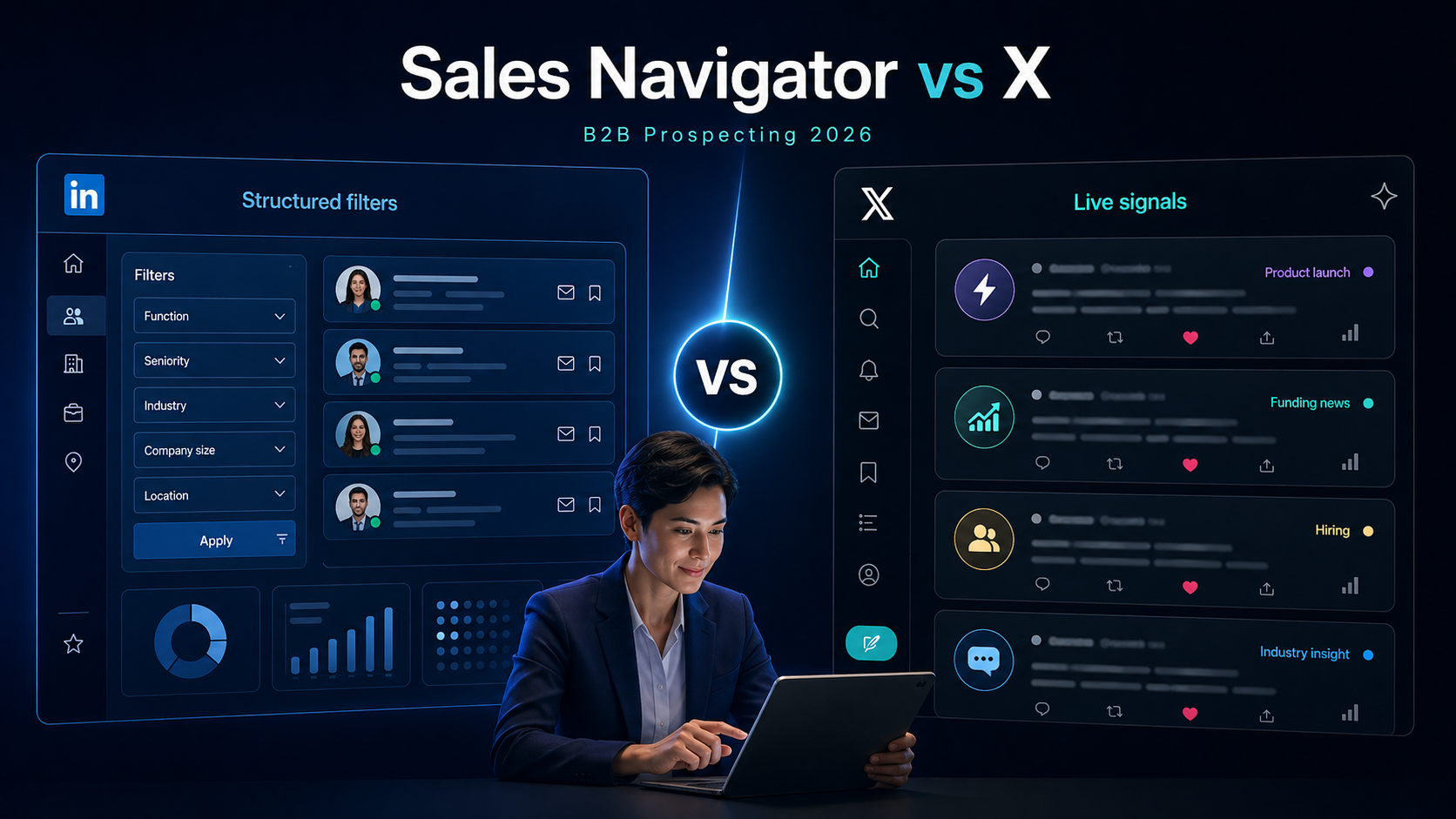
If your team has been on LinkedIn Sales Navigator for years and you're starting to wonder why InMail response rates keep drifting down — you're not imagining it. The 2026 numbers tell a real story: Sales Navigator still wins on lead quality, but X has quietly become the highest-signal channel for catching B2B buyers before they enter a formal evaluation. The right question isn't "Sales Navigator vs. X" as a binary choice. It's where each channel earns its slot in your prospecting stack, and how much of your week each one deserves.
This guide compares the two on the metrics that actually drive pipeline: cost, response rates, audience composition, signal quality, and time-to-conversation. You'll get a clear framework for splitting prospecting time between Sales Navigator and X, plus the specific scenarios where each platform outperforms.
TL;DR
- Sales Navigator wins on lead quality and conversion rate. 12–18% of qualified Sales Nav leads convert to opportunities vs. 4–8% on X. InMail response rates run 18–25% (top performers 30–40%).
- X wins on cost, signal speed, and audience access. No per-seat fees, real-time intent signals, and a concentrated audience of founders, technical buyers, and high-income professionals (27% of Americans earning $100K+ are on X).
- Sales Navigator costs $99–$179/user/month (Core/Advanced) with Advanced Plus running ~$1,600/seat/year. X has no platform cost — your cost is the API tier (pay-per-use as of Feb 2026) or the automation tool you use.
- The optimal allocation for most B2B teams is roughly 60–70% Sales Navigator, 20–30% X, with X used for top-of-funnel signal detection and warm-lead surfacing — not cold pitching.
- The teams getting the best results use both: X to find buyers showing intent, Sales Navigator to multi-thread the account once a conversation starts.
What "B2B Prospecting" Actually Means on Each Platform
Before comparing the two, it's worth being precise about what each platform is built to do — because the surface-level similarity ("you can find prospects on both") hides very different mechanics.
Sales Navigator
is a structured database with messaging on top. You search by 30+ filters (job title, company size, geography, hiring trends, technology used), build saved lead lists, monitor accounts for trigger events like job changes, and reach out via InMail. The platform is designed for one-to-one structured outbound and account-based selling. Every interaction is private, professional, and tracked.
X
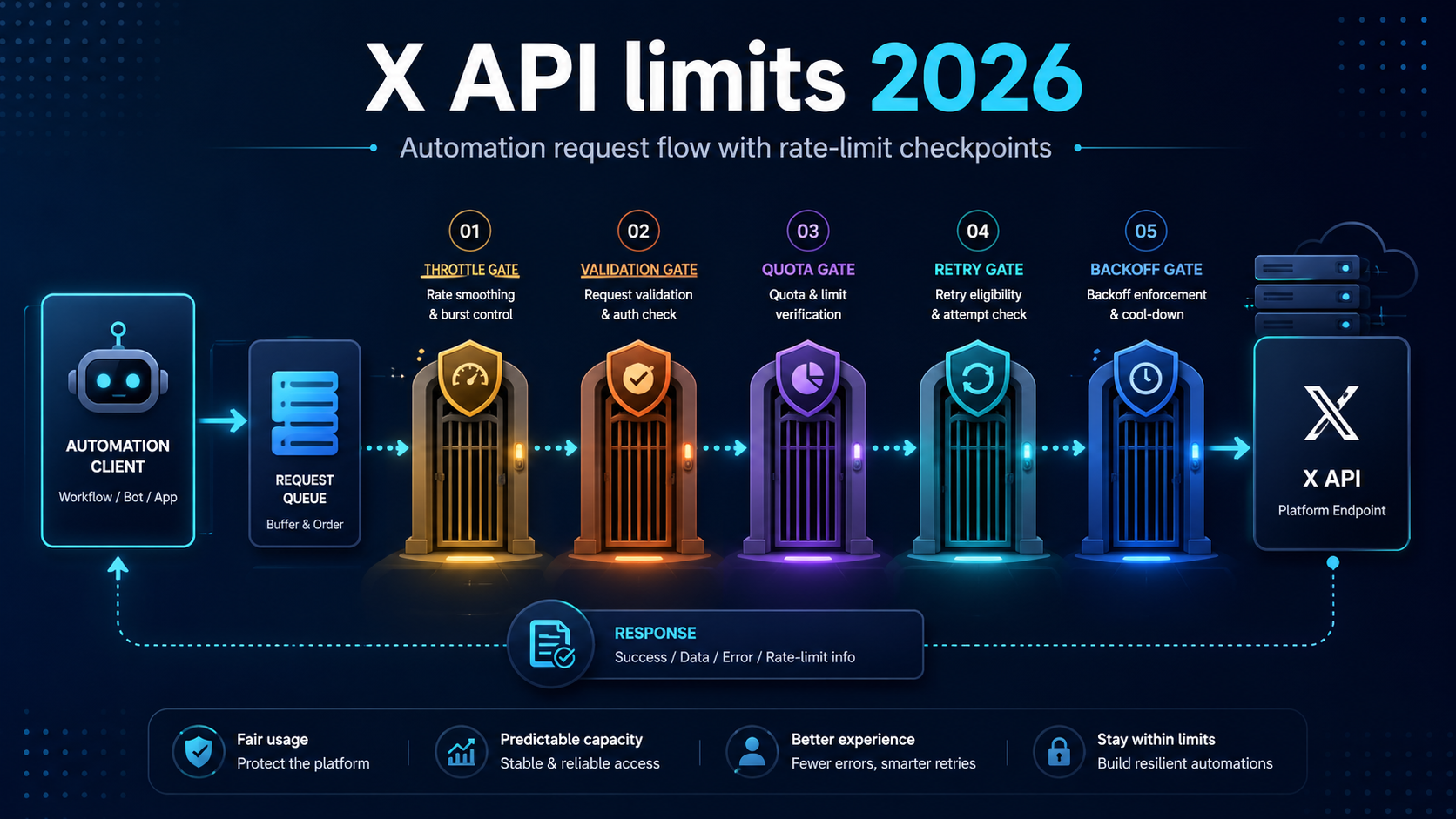
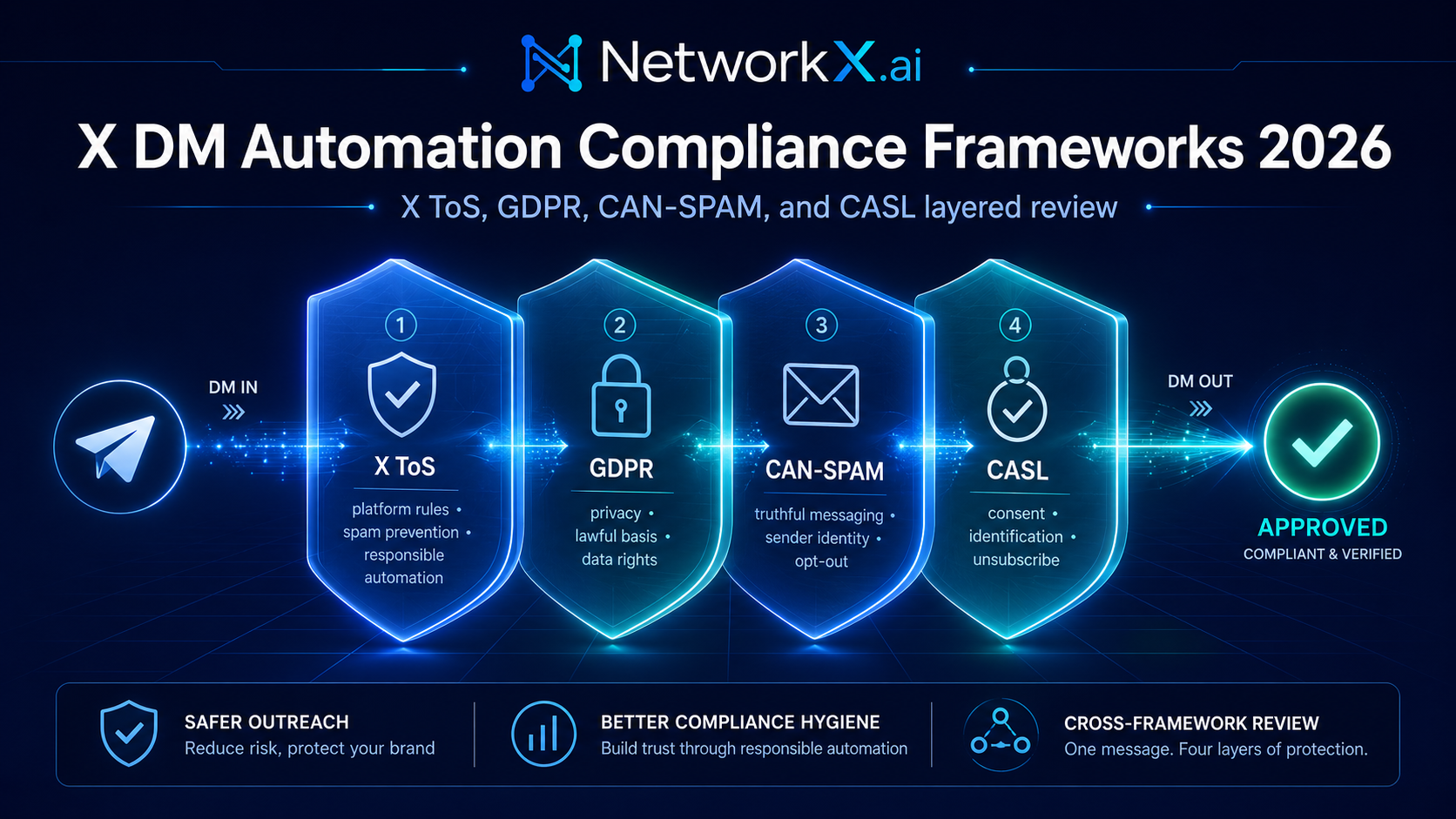
is a public conversation graph with messaging underneath. You find prospects by their public activity — what they post, what they engage with, what they complain about, who they follow. There's no formal database. You build lists by tracking conversations, replies, and intent signals in real time. Outreach happens publicly first (replies, quote-tweets) and privately second (DMs, but only with strict compliance — see
X API limits in 2026
).
The mental model: Sales Navigator answers "who fits my ICP?" X answers "who's signaling buying intent right now?"
Cost Comparison: Sales Navigator vs. X in 2026
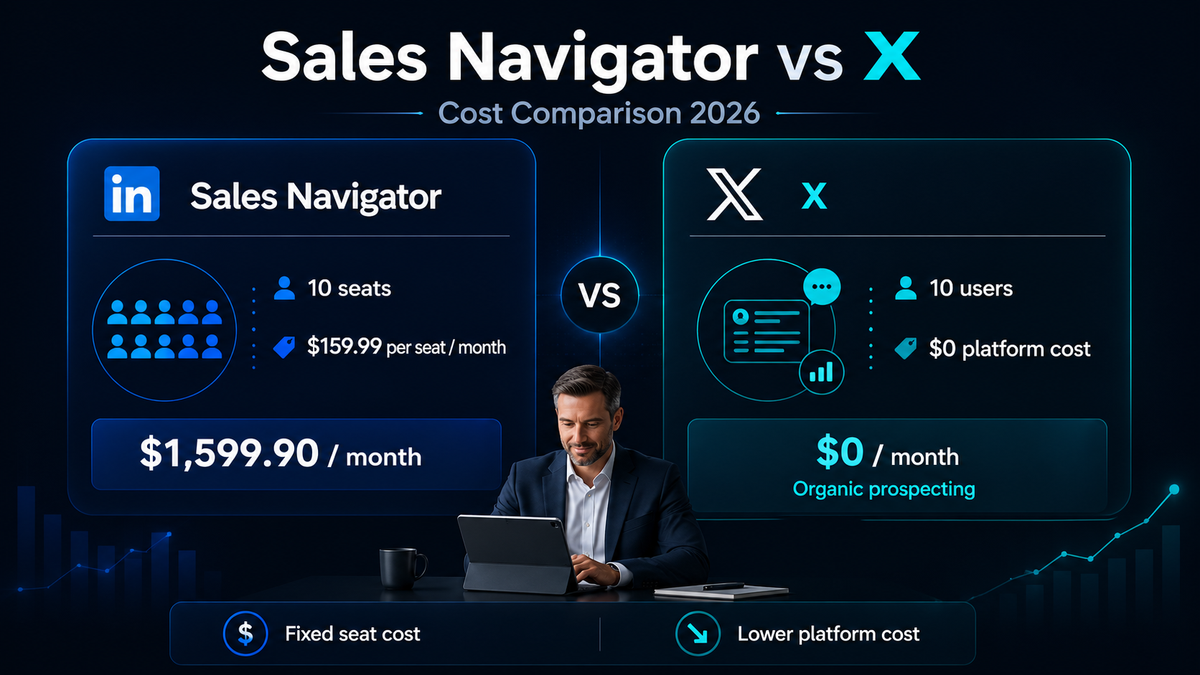
This is where the math gets interesting.
Sales Navigator pricing (2026)
LinkedIn restructured pricing slightly in 2026, but the headline numbers are well-documented:
- Core: $99.99/user/month (annual) or $119.99/month — basic search, 50 InMail credits/month, lead alerts, CRM sync (limited)
- Advanced: $139.99/user/month (annual) or $179.99/month — adds TeamLink, Smart Links, Account IQ AI summaries, buyer intent signals, collaborative lead lists
- Advanced Plus: ~$1,600/seat/year (custom pricing) — full CRM integration, ROI reporting, embedded LinkedIn data inside Salesforce/HubSpot/Dynamics
For a 10-person sales team on Advanced billed annually, you're looking at ~$17,000/year. For Advanced Plus, ~$16,000/year for the same team — but with significant enterprise-grade features.
X pricing (2026)
X has no per-seat platform cost. Your costs are:
- API access: Under the February 2026 pay-per-use model, post creation runs ~$0.010 per call and reads ~$0.005. A typical outbound workload (5,000 prospect lookups + drafted messages per month) costs roughly $50–100/month total for the entire team.
- Automation tooling: If you're using a smart assistant for X to surface prospects and draft outreach, expect $30–150/user/month depending on the platform.
- X Premium (optional but increasingly necessary): $8–22/user/month for verified status, higher DM caps, longer posts.
For that same 10-person team, total monthly cost lands somewhere between $400 and $1,800/month — anywhere from 4× cheaper to 10× cheaper than Sales Navigator at the same scale.
What you give up at the lower price point
The cost gap isn't free. Sales Navigator buys you a structured database, real-time profile updates pulled directly from LinkedIn (every job change, role update, company move), and a controlled environment optimized for B2B. X gives you signal and reach at low cost — but you're working in public, navigating the platform's automation rules, and managing a noisier conversation graph.
Response Rate Reality Check: What the 2026 Data Shows
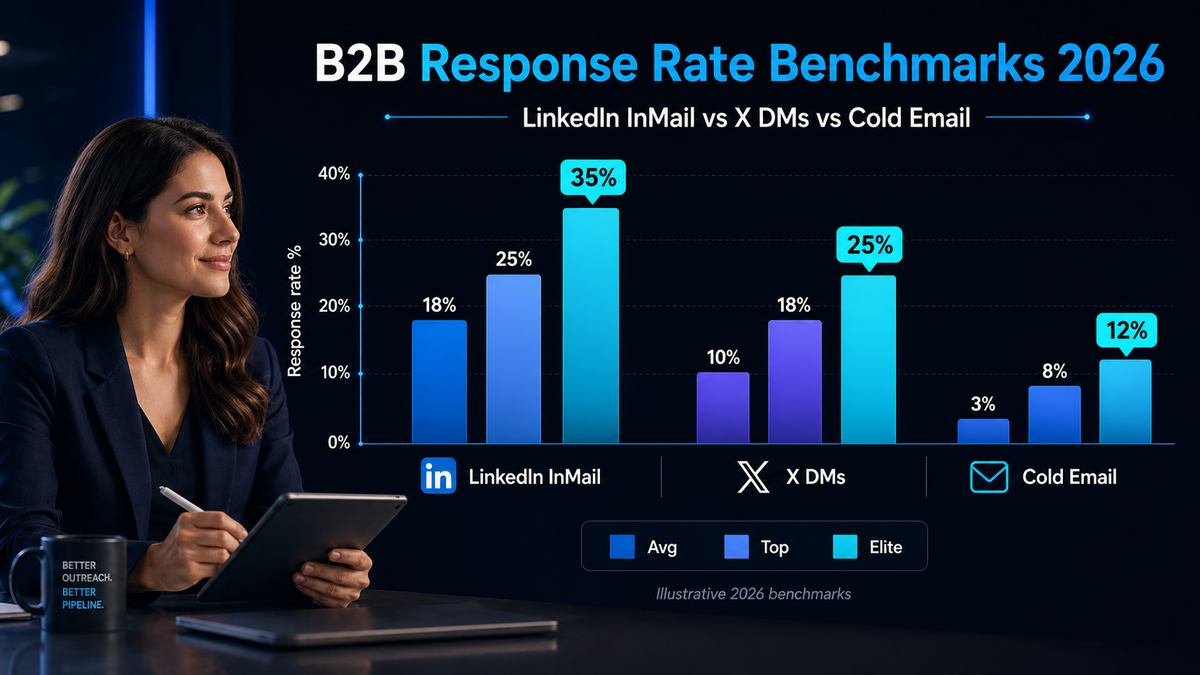
This is the most-asked question in any Sales Nav vs. X comparison, and the data is now solid enough to answer cleanly.
Sales Navigator / LinkedIn InMail
The 2026 benchmark data from LinkedIn and independent analyses:
- Average InMail response rate: 10–25%, with high performers consistently hitting 18–25% and elite tier crossing 30–40%
- InMail open rate: ~57.5% — nearly 100% deliverability vs. 83% for cold email
- Tech & SaaS specifically: 4.77% average — the hardest vertical because of automation saturation
- Conversion to opportunity: ~12–18% of qualified leads
- Average deal size: ~2.5× larger than leads from other social platforms
- Sales cycle: ~30% shorter due to professional context and intent
X DMs and replies
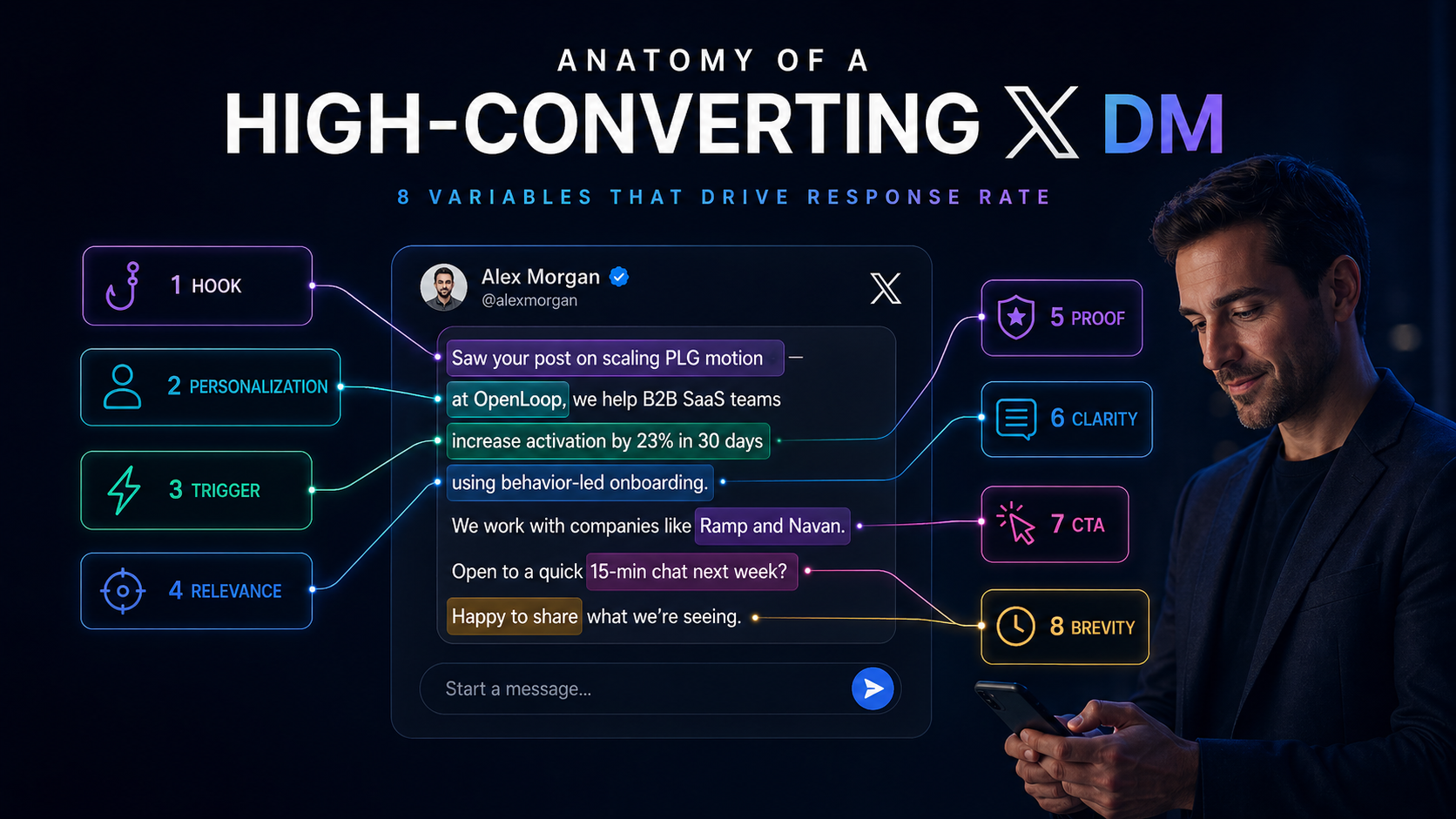
Pure cold DM data on X is harder to benchmark because X explicitly prohibits programmatic cold DMs (see X's Automation Rules). What we can measure is engagement on warm, signal-based outreach — replies and DMs that follow public engagement:
- Reply-to-reply conversion (someone responds to your reply on a public tweet): typically 8–15% in B2B contexts
- DM response rate after established public engagement: can run as high as 25–35% — but only after the relationship is warmed publicly
- Conversion to opportunity: ~4–8% of engaged X leads
- Lead quality match to ICP: ~45% (vs. 85% on Sales Navigator)
How to read these numbers
The headline is that Sales Navigator wins on raw conversion. But there's a critical asymmetry the headline misses: Sales Navigator response rates are dropping — from 18–25% historically toward 10–15% in saturated verticals — while X engagement, when properly signal-based, is improving because the audience is less saturated by automation.
The teams getting the best results aren't picking one. They're using X to identify which Sales Navigator leads to actually message.
Audience: Who's Actually Reachable on Each Platform?
| Audience attribute | Sales Navigator (LinkedIn) | X |
|---|---|---|
| Concentration of B2B decision-makers | Very high — by design | High in tech/SaaS/finance/media; lower in traditional sectors |
| C-suite and senior leadership | Comprehensive (job titles verified) | Strong but uneven — many execs lurk, fewer post |
| Founders / solopreneurs | Strong | Disproportionately strong — startup founders are X-native |
| Technical buyers (engineering, security, data) | Present but harder to reach | Disproportionately strong — devs, infra leaders, and CTOs are highly active |
| Income concentration | Even distribution across professional incomes | 27% of Americans earning $100K+ use X (highest income concentration of any platform) |
| Education concentration | High | 27% of college-educated Americans (~2× the high-school-educated rate) |
| Geographic | Global, broadly distributed | US-heavy (~33% of users), Japan, India, Indonesia |
The audience nuance matters more than the totals. For traditional B2B sectors — manufacturing, professional services, healthcare, finance — LinkedIn is where the buyers actually engage. For tech, SaaS, dev tools, fintech, AI, media, and founder-led purchases — X frequently outperforms because the buyer is actually paying attention there.
Signal Quality: Where X Has a Structural Advantage
This is the dimension where most Sales Nav vs. X comparisons fail. They compare the platforms as static databases. The real difference is how fresh the buying signals are.
Sales Navigator surfaces trigger events: job changes, funding rounds, company growth signals, hiring patterns. These are valuable — but they're lagging indicators. By the time a job change shows up in your feed, the person has already been onboarding for a week.
X surfaces active intent in real time:
- A founder tweets "anyone have a recommendation for [your category]?" — that's a buyer in evaluation mode
- A CTO complains about a competitor — that's pain, public, dated, and addressable
- A VP of sales asks about pricing models — that's an entry point into a sales conversation
- A growth marketer shares their stack — you now know exactly what's adjacent to your product
This kind of signal exists on LinkedIn too, but it's drowned out by personal-brand content and corporate posts. On X, the signal-to-noise ratio for buying intent is substantially higher — if you have a tool that surfaces it for you. Manually monitoring X for prospect signals is a full-time job.
A Practical Framework: How to Split Time Between Sales Navigator and X
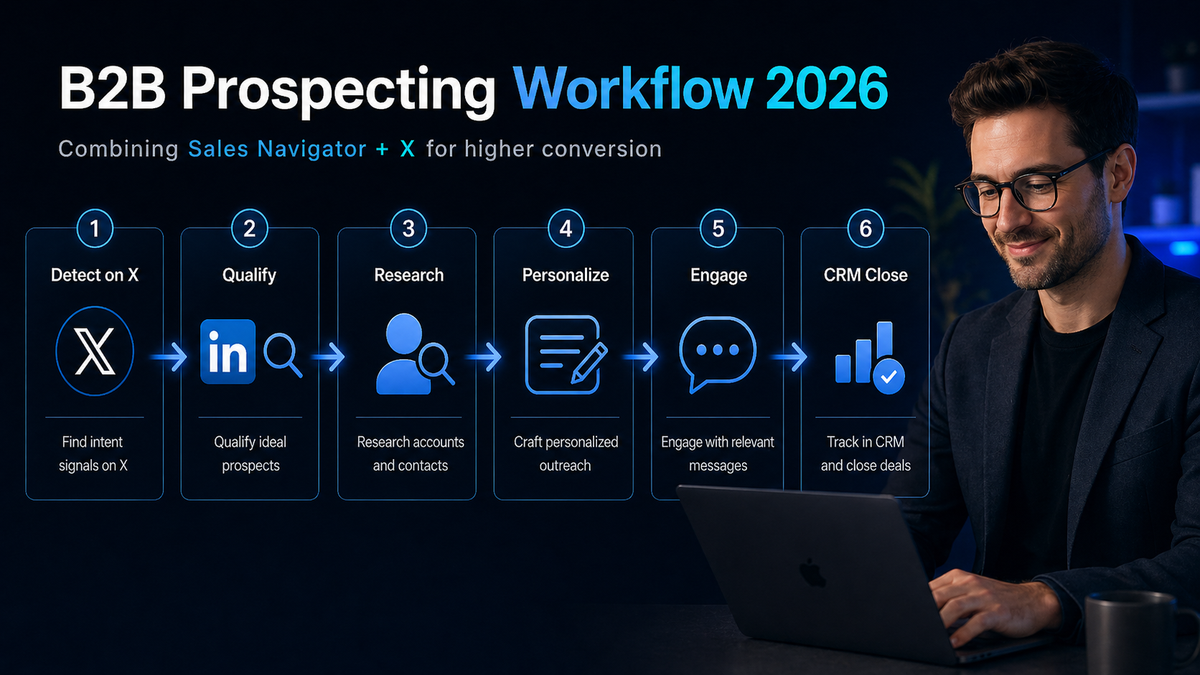
For most B2B teams, the question isn't which platform to choose. It's how to allocate hours. Here's the framework that's working in 2026:
Use Sales Navigator for:
- ICP search and account list building. No tool matches its filtering precision and CRM integration.
- Account-based selling. Multi-threading into target accounts where you need to map a buying committee.
- Trigger-event outreach. Job changes, funding rounds, role expansions — InMail is still the fastest path to a structured response.
- Late-funnel work. When a deal exists in your CRM and you need to reach a specific stakeholder.
Use X for:
- Real-time intent detection. Catching prospects when they're actively expressing pain, evaluating tools, or asking peer recommendations.
- Warm-up before reach-out. Engaging publicly with a prospect's content for 1–2 weeks before any direct message — this dramatically lifts InMail and DM response rates on either platform.
- Top-of-funnel discovery. Finding companies and people who don't yet appear in your CRM.
- Founder and dev-tool sales. When your buyer is X-native, this is the primary channel.
- Building inbound. A consistent presence on X turns cold outbound into "I've seen your content — happy to chat" replies.
Suggested time allocation (10 hours/week of prospecting)
- 6 hours on Sales Navigator — list building, InMail sequences, CRM-driven outreach
- 3 hours on X — signal monitoring, public engagement, warm-DM follow-up to engaged prospects
- 1 hour on cross-platform coordination — connecting X intent signals to Sales Navigator account lists
This balance flips for early-stage founders and dev-tool sellers, where X often deserves 60–70% of the time.
Where the Stack Actually Lands in 2026
The most effective B2B teams aren't running these platforms in parallel. They're running them in sequence:
Detect on X
— a smart assistant surfaces prospects expressing buying intent in real time
Enrich on Sales Navigator
— pull in firmographics, role, company context, buying-committee map
Warm on X
— engage publicly for 1–2 weeks (replies, helpful comments, no pitch)
Open on either platform
— InMail when the structured-channel context fits; DM when the relationship is established
Multi-thread on Sales Navigator
— once a conversation starts, expand into the buying committee using TeamLink and Account IQ
Close in CRM
— Salesforce / HubSpot / Dynamics, with Sales Navigator embedded data
The teams running this sequence are the ones beating both their LinkedIn-only and X-only peers in 2026 conversion data.
How NetworkX.ai Fits Into This Workflow
NetworkX.ai is built for the X side of this stack — the part that's hardest to do manually. The platform monitors X for prospects expressing buying intent, surfaces them with context, drafts personalized outreach for human review, and keeps the entire workflow inside X's automation rules for the 2026 enforcement environment.
For teams already running Sales Navigator, NetworkX.ai isn't a replacement — it's the missing front-end. The job-change alerts and ICP filtering Sales Nav is great at don't surface the prospect who tweeted "evaluating [your category] this quarter" three hours ago. That's the gap a smart X assistant fills.
If you're rebuilding your B2B prospecting stack for 2026 — or just trying to figure out whether X deserves a slot alongside Sales Navigator — start a free trial and see what the X signal layer looks like in practice.
Frequently Asked Questions
Is Sales Navigator still worth it in 2026?
For most B2B teams targeting mid-market and enterprise accounts, yes — Sales Navigator remains the highest-converting structured outbound channel, with 18–25% average InMail response rates and 12–18% conversion-to-opportunity rates. It's harder to justify for teams selling to founders, dev-tool buyers, or technical audiences who are more reachable on X. The Core plan at $99.99/month is the entry point most individual reps and small teams find ROI-positive.
Can X replace Sales Navigator for B2B prospecting?
For most B2B sectors, no. X lacks the structured database, ICP filters, and CRM integration that make Sales Navigator effective for account-based selling. However, X offers something Sales Navigator can't: real-time buying intent signals from public conversations. The strongest 2026 prospecting strategies use both — X for signal detection and warm-up, Sales Navigator for structured outreach and account multi-threading.
What's the average response rate on Sales Navigator InMail vs. X DMs?
Sales Navigator InMail averages 10–25% response rates, with top performers hitting 30–40%. X cold DMs are explicitly prohibited by X's automation policy, but warm DMs following public engagement can reach 25–35% in B2B contexts. The methodology is fundamentally different: Sales Navigator measures structured outbound; X measures relationship-based outreach.
How much does X cost compared to Sales Navigator for a sales team?
A 10-person sales team on Sales Navigator Advanced pays roughly $17,000/year. The same team using X for prospecting pays $0 in platform fees, plus ~$50–100/month in API costs (under X's February 2026 pay-per-use pricing) and optional automation tooling at $30–150/user/month. Total cost on X is typically 4–10× cheaper than Sales Navigator at the same team size — but the platforms serve overlapping rather than identical functions.
Which platform is better for finding decision-makers in tech and SaaS?
Both work, but they reach different segments. Sales Navigator is stronger for VPs and director-level buyers at established companies — they're consistently active on LinkedIn for career and professional reasons. X is stronger for founders, technical buyers (engineering, security, infrastructure), and product-led growth purchases where the user, not procurement, drives the decision. Tech and SaaS sellers typically use both with X weighted higher than for traditional B2B sectors.
Is automation safer on Sales Navigator or X?
Neither platform welcomes aggressive automation, but they enforce differently. LinkedIn caps connection requests at ~100/week and actively detects automated InMail patterns. X explicitly prohibits programmatic cold DMs and has run an aggressive bot purge throughout 2026. The compliant approach on both platforms is the same: use tools to surface prospects and draft messages, but require meaningful human participation in each send.