GTM Engineering on X: How Modern Revenue Teams Are Replacing Traditional Outbound
The economics of B2B outbound broke in 2025. According to the 2025 Benchmarkit report, companies are now spending roughly $2 in sales and marketing to earn $1 of new ARR — a 14% jump from 2024. SDR ramp times stretched. Reply rates collapsed across email and LinkedIn. And the linear "more headcount = more pipeline" formula stopped working.
Out of that pressure, a new discipline emerged: GTM engineering — the practice of designing automated, signal-based revenue systems that generate pipeline without proportional headcount growth. The category is real, mature, and now central to how high-efficiency B2B companies operate. The median GTM engineer now earns $127,500 in the US, with top employers paying $250K+. And the role is reshaping which channels actually belong in a modern outbound stack.
This piece covers what GTM engineering is, why it's eating traditional outbound, and — most importantly — why X is becoming a first-class signal layer in the modern GTM stack, sitting alongside Clay, Apollo, HubSpot, and Salesforce as a primary source of real-time buying intent.
- GTM engineering replaces manual SDR work with automated, signal-based revenue systems. The role didn't exist three years ago. It's now one of the fastest-growing positions in B2B revenue teams.
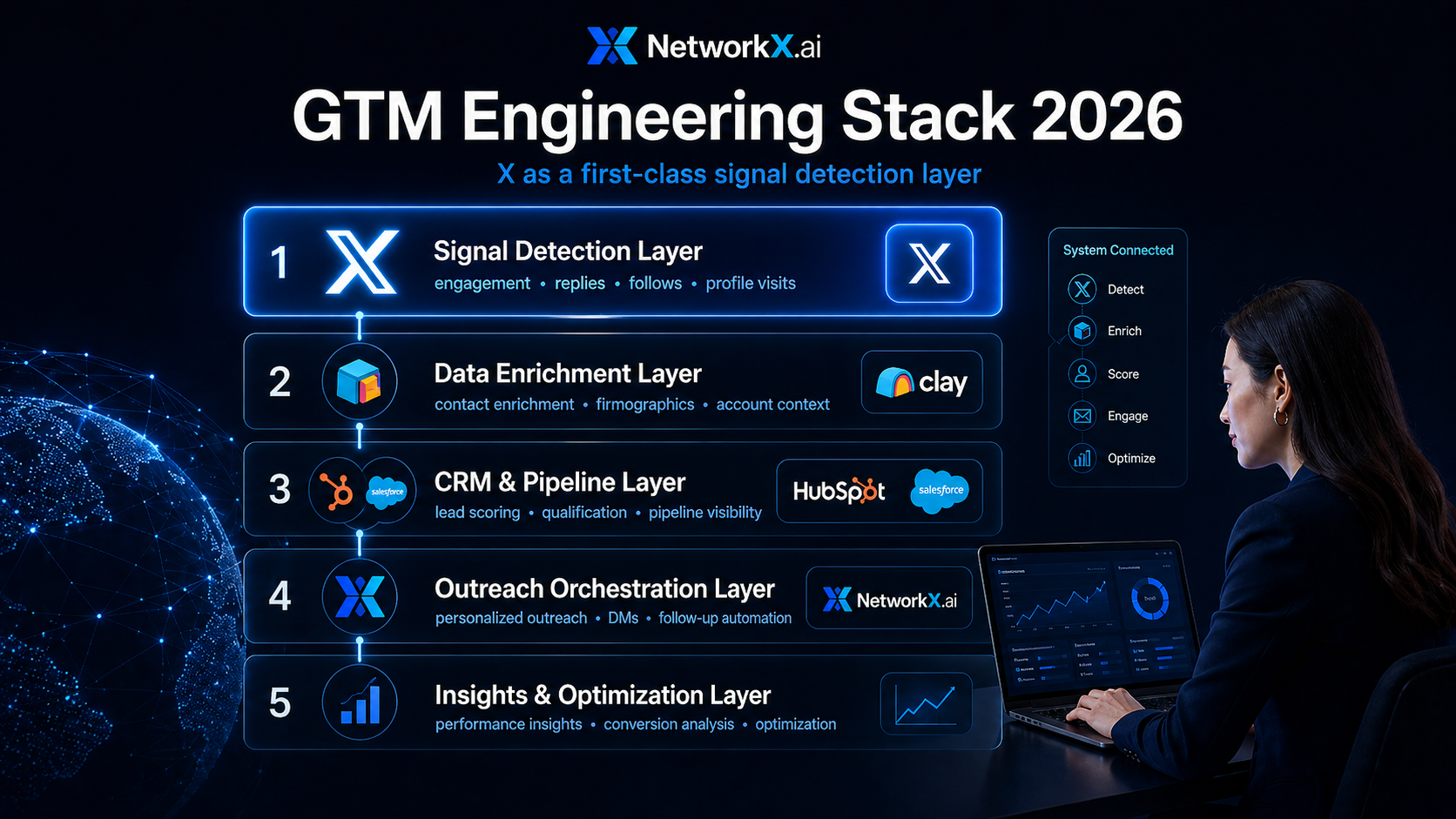
- The modern stack has 5 layers: Signal detection → Enrichment → Scoring/routing → Outreach orchestration → CRM. Each layer is a build, not a buy decision.
- The biggest 2026 shift is signal-based selling. Static lists are out. Real-time intent signals are in. The 2025 buying cycle is so compressed that signals older than 14 days are noise.
- Social intent signals — including X — are now ranked the highest-value signal type because they represent explicit, unfiltered buying intent. Multiple 2026 frameworks (Apollo, Buska, Bitscale, MarketBetter) cite social as the top tier.
- X as a GTM signal source is structurally underexploited. Most stacks include LinkedIn, web visitor ID, G2, and Bombora — but miss the place where founders, technical buyers, and product-led purchases actually express intent in real time.
- The integration pattern is straightforward: X-sourced signals feed Clay or Apollo for enrichment, score against your ICP in HubSpot/Salesforce, trigger personalized outreach, and route replies to the right rep.
What Is GTM Engineering, Actually?
The short version: GTM engineering applies the rigor of software engineering to revenue operations. Instead of hiring more SDRs, you build systems.
A GTM engineer's job is to design, build, and maintain the automated infrastructure that powers modern go-to-market. That includes data enrichment pipelines, signal detection systems, lead scoring models, CRM integrations, and outreach orchestration that runs without manual intervention at each step. The output is a system, not a campaign.
The role emerged around 2024 as B2B companies hit the limits of headcount-driven growth. By 2026, it's mature enough to have its own state-of-the-industry survey. The 228-respondent 2026 State of GTM Engineering report found:
- 88% of GTM engineers build on Salesforce or HubSpot as the system of record
- Median US base salary: $135K, with senior practitioners crossing $200K
- The most common transition path: SDR/BDR → GTM engineer (pipeline instincts + technical skills)
- Top tools cited: Clay, HubSpot, Outreach, Salesforce, Zapier, Apollo, n8n, Gong
What makes the discipline new is that AI has dramatically lowered the cost of personalization at scale. As DevCommX's Sumit Nautiyal put it: "In 2020, sending 1,000 genuinely personalized outbound messages required 10 SDRs. In 2026, it requires one GTM engineer, a well-configured stack, and a well-defined ICP."
That economic shift is what's driving the category. Not the AI hype cycle. The unit economics.
Why Traditional Outbound Stopped Working
Three structural shifts converged between 2023 and 2025:
1. Inbox saturation crossed a threshold.
Decision-makers receive 100+ sales emails per week. Open rates dropped from ~36% in 2023 to ~27% in 2024. Reply rates compressed from 7% to 3.43% on platform-wide averages.
2. CAC inflation accelerated.
B2B teams now spend $2 to earn $1 of new ARR — a 14% increase in a single year. Adding more SDRs hits diminishing returns fast.
3. Buying behavior changed.
81% of B2B buyers complete most research before talking to a rep (Gartner 2025). The funnel inverted: by the time someone fills a form, they've often already shortlisted vendors.
The combined effect: volume-based outbound stopped scaling, and the teams that survived shifted from spray-and-pray to precision targeting based on real buyer signals. That shift is what GTM engineering operationalizes.
The 5-Layer GTM Engineering Stack
Every modern GTM stack has the same five functional layers. Tools change; layers don't.
Layer 1: Signal Detection
This is the foundation. You need to know which companies are in-market right now, not just which fit your ICP profile on paper. Signals include:
- Hiring signals — a company posting 10 SDR roles is scaling sales
- Funding signals — Series A/B companies are typically in aggressive growth mode
- Technographic signals — switching tools, adopting new stacks
- Intent signals — research activity on review sites, category surges
- Social signals — public expressions of pain, vendor evaluation, peer recommendations
- Job change signals — new VPs, CROs, RevOps leaders entering target accounts
Layer 2: Enrichment
Take raw signals and add context: contact details, firmographic data, technographic stack, recent activity. Clay dominates this layer in 2026, with HubSpot, Apollo, ZoomInfo, and Clearbit feeding into it.
Layer 3: Scoring and Routing
Combine fit (does this match my ICP?) with timing (are they in-market right now?) into a composite score. Route the highest-scoring accounts to the right rep within 30 minutes — speed-to-signal is the critical operational metric in 2026, and top-performing teams act on signals within that window.
Layer 4: Outreach Orchestration
Multi-channel sequences (email + LinkedIn + phone, increasingly + X DM) running 8–12 touchpoints over 21–30 days, with AI-personalized messages tied to the specific signal that triggered the sequence.
Layer 5: CRM and Attribution
Salesforce or HubSpot as the system of record. Every signal, message, and reply logged. Attribution back to the originating signal so the team knows which signal sources are actually generating pipeline.
Where X Fits in the Modern GTM Stack
This is where most 2026 GTM stacks have a gap.
The dominant intent data providers — Bombora, 6sense, Demandbase, G2 Buyer Intent, ZoomInfo — all do something specific: they track research behavior on B2B publisher networks and review sites. That's valuable signal, but it has three structural limitations:
It's almost always company-level, not person-level.
You learn an account is researching, but not who.
It's lagging.
Most providers refresh weekly or daily; some run on multi-week batch cycles.
It misses where technical buyers actually research.
Engineers, founders, security leaders, and product-led buyers don't browse generic B2B publisher networks. They're on X, Reddit, Hacker News, and Discord.
This is why multiple 2026 frameworks now explicitly rank social intent signals as the highest-value signal type. From Buska's 2026 signal-based selling guide: "Social intent signals — someone asking for recommendations or complaining about a competitor on social media — are the highest-value signals because they represent explicit buying intent. Website behavior signals like repeated pricing page visits rank second."
The hierarchy that emerges in 2026:
| Tier | Signal Type | Why |
|---|---|---|
| 1 | Social intent (X/Reddit/HN posts asking for recommendations, complaining about tools, evaluating competitors) | Explicit, unfiltered, person-level, real-time |
| 2 | Pricing page / repeat website visits | Strong but anonymized at company level |
| 3 | Job changes (new buyer entering account) | Strong fit signal, requires soft entry |
| 4 | Funding events | Budget signal, earlier-stage |
| 5 | Topic research surges (Bombora, etc.) | Useful but lagging and account-level only |
The argument isn't that X replaces other signal sources. It's that X is a structurally distinct signal source — one that captures the moment of explicit, person-level buying intent that other layers can't see.
What X Signals Look Like in Practice
The signal types worth detecting on X for B2B GTM:
Recommendation requests.
"Anyone have a recommendation for [your category]?" These are the highest-intent signal possible — a buyer publicly declaring they're in evaluation mode. Response window: under 60 minutes for best results.
Competitor pain.
A user complaining about a competitor's pricing, support, missing feature, or recent change. The buyer is in-market and unhappy with their current vendor.
Tool evaluations.
Public threads where buyers ask peers to compare options, share stack screenshots, or solicit migration stories.
Role-change announcements.
"Excited to share I just started as VP of [X] at [Company]" — same job-change signal LinkedIn surfaces, but on X you can engage publicly first, which dramatically warms the relationship before any DM.
Hiring threads.
"We're hiring [role] — DM me" indicates team scaling, which often correlates with stack expansion in your category.
Conference and community engagement.
Live posts from industry events, replies in technical threads — high-intent context for selling to technical audiences.
The Integration Pattern: How X Plugs Into a Modern GTM Stack
The cleanest 2026 architecture for adding X as a signal layer:
[X Signal Detection] → [Enrichment via Clay or Apollo] → [Scoring in HubSpot/Salesforce] → [Routing to rep] → [Personalized outreach]
Concretely, that flow looks like this:
1. Signal capture on X.
A monitoring tool watches public X activity for relevant trigger phrases, competitor mentions, recommendation requests, or pain expressions in your category.
2. Enrichment.
Pipe the X handle into Clay or Apollo to get the full firmographic profile: company, role, company size, tech stack, funding, location.
3. ICP scoring.
Score the signal in your CRM using fit (firmographic match) + timing (signal recency and strength). Top-tier signals route to AE/SDR within 30 minutes.
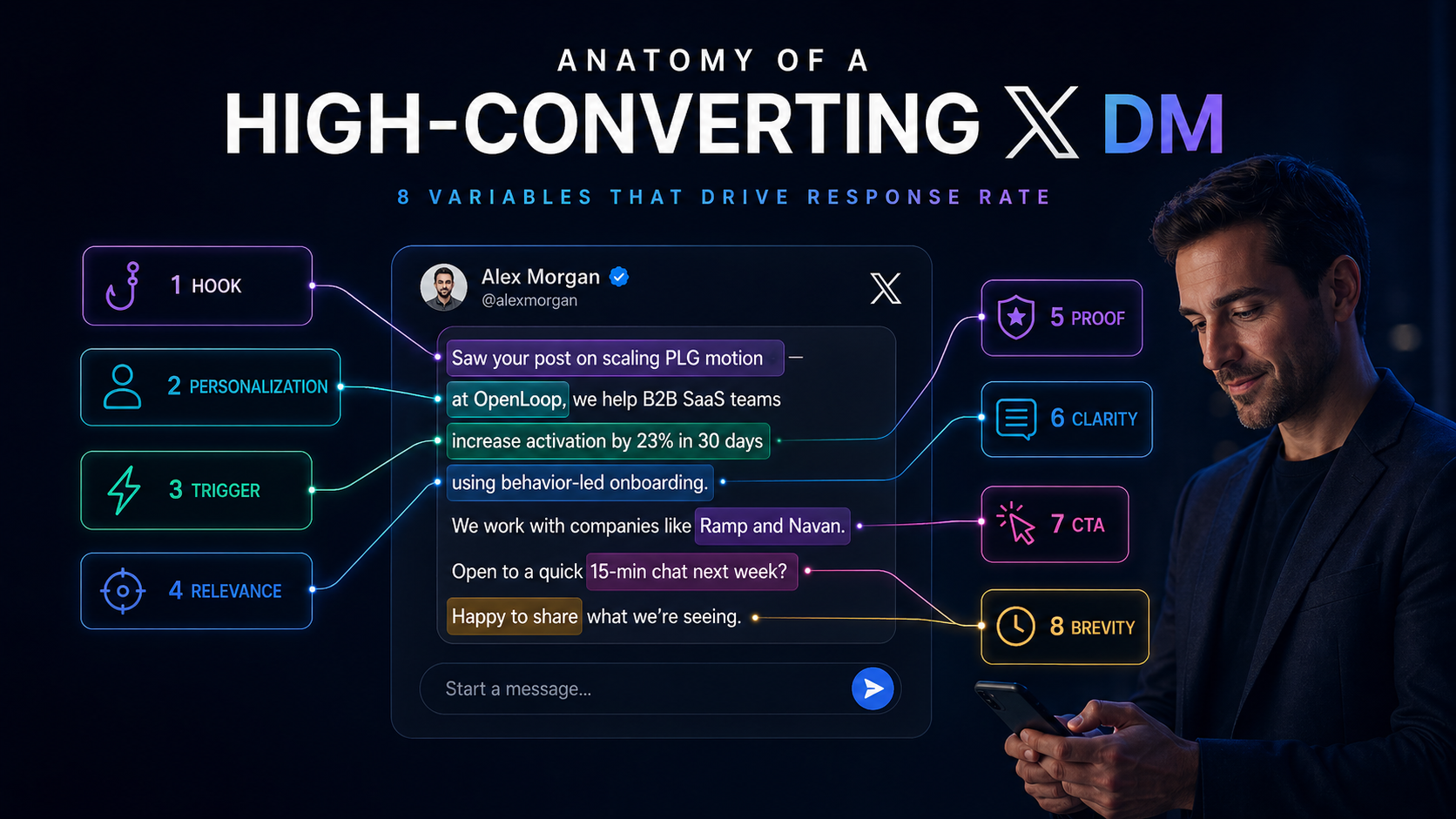
4. Personalized outreach.
The outreach references the original X signal —
not
a generic pitch. "Saw your post about [specific thing]" anchored to a specific public utterance that's hard to fake and reads as attention rather than templated outbound.
5. Multi-channel coordination.
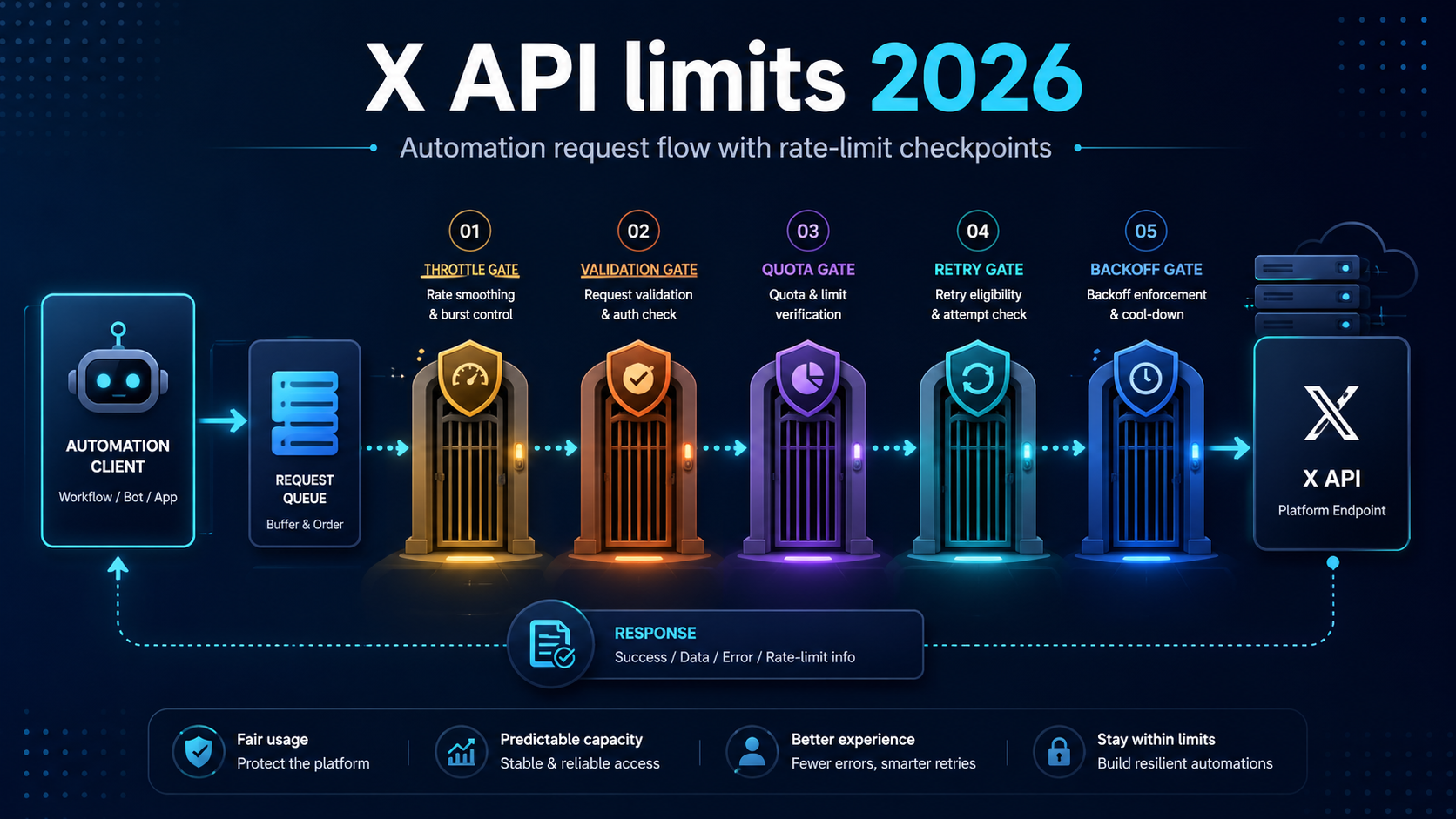
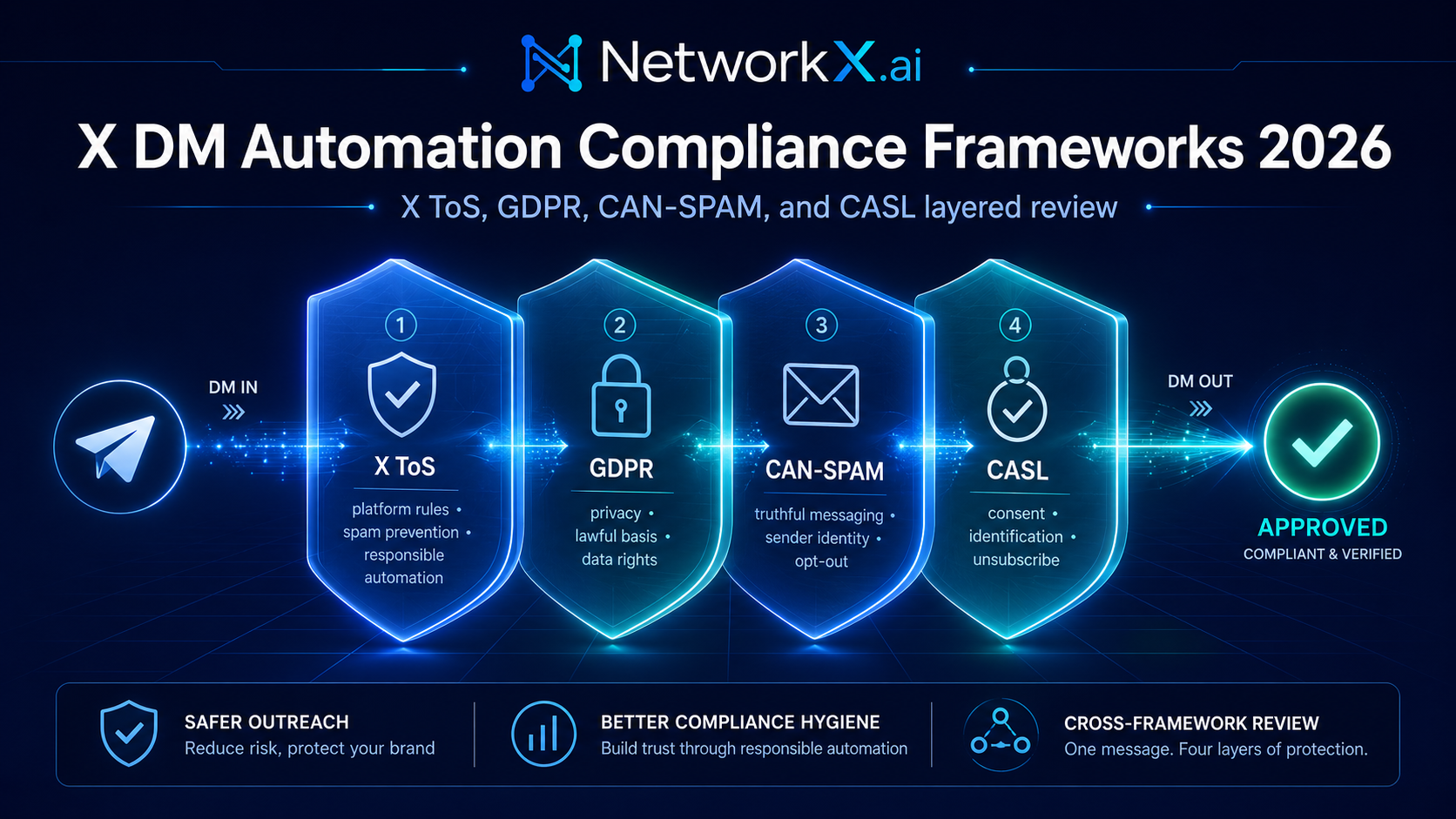
The X signal can trigger touches across email, LinkedIn, and an X DM (subject to compliance — see
X API limits in 2026
). Each channel reinforces the others.
6. Attribution.
Every meeting booked tags back to "X-sourced" so the team can measure pipeline contribution from social signals separately from website intent and outbound lists.
Why This Matters for Founders, Tech Sellers, and Product-Led Companies
The case for X-sourced signals is strongest for three categories of B2B seller:
Founders selling to other founders.
Founders are X-native. The buyer for a founder-led B2B product is more reachable on X than anywhere else, and the signals come through the platform first.
Technical sellers (dev tools, infrastructure, security, AI).
Engineers and CTOs research on X, Hacker News, GitHub, and technical Discord communities — not on G2 or LinkedIn. Generic B2B intent platforms miss these signals entirely.
Product-led companies.
When the user, not procurement, drives the decision, X is where those users discuss tools, compare options, and ask for recommendations. By the time intent shows up on a review site, the decision has often already been made.
For traditional B2B sectors selling to procurement-led mid-market and enterprise buyers — manufacturing, financial services, healthcare administration — LinkedIn-led and intent-data-led stacks remain the core, with X as a complement. The point isn't that X replaces everything. It's that for the fastest-growing segments of B2B in 2026 — AI, dev tools, fintech, infrastructure, founder-led SaaS — X is now structurally underweighted in most GTM stacks.
The Build vs. Buy Question
If you're a GTM engineer or RevOps leader looking to add X as a signal layer, the build vs. buy decision comes down to two questions:
1. Do you have GTM engineering capacity to build it yourself?
Building X signal detection in-house means: an X API integration (under 2026 pay-per-use pricing), trigger keyword libraries, enrichment routing into Clay/Apollo, scoring rules in HubSpot/Salesforce, and compliance enforcement around X's automation rules. For a Series A/B team, this is realistic but not trivial — figure 60–90 days to a working v1.
2. Do you have real-time monitoring needs?
The half-life of an X recommendation request is roughly 60 minutes. If your stack can't detect, route, and trigger outreach within that window, you're losing the signal. Built-in-house systems often miss this latency target on v1.
For most teams, buying the X signal layer and integrating it into the existing GTM stack is faster, cheaper, and easier to maintain than building from scratch. The integration points (Clay, HubSpot, Salesforce, Outreach) are well-defined.
How NetworkX.ai Fits Into the Modern GTM Stack
NetworkX.ai is built specifically as the X signal layer in a modern GTM engineering stack. The platform monitors X for high-intent buying signals, surfaces them with full context, drafts signal-anchored personalized outreach for human approval, and integrates upstream into Clay/Apollo for enrichment and downstream into HubSpot/Salesforce for routing and attribution.
For GTM engineers building modern outbound stacks, NetworkX.ai is the missing front-end — the part of the funnel that captures explicit, person-level buying intent in real time, before it shows up on a review site or in a job change alert.
If you're rebuilding your GTM stack for 2026 and want to see how X signal detection plugs into Clay, HubSpot, and your existing outreach orchestration, start a free trial — or book a consultation to walk through your specific stack architecture.
Frequently Asked Questions
What is GTM engineering?
GTM engineering is the practice of designing, building, and maintaining automated systems that power B2B revenue operations. Instead of relying on manual SDR work and disconnected tools, GTM engineers wire together data sources, AI models, enrichment platforms, and sequencing tools into a unified, signal-based outbound engine. The role emerged around 2024 and is now one of the fastest-growing positions in B2B revenue teams, with median US salaries at $127,500–$135,000 and senior practitioners earning $200K+.
What tools are in a modern GTM engineering stack in 2026?
The most-cited tools in the 2026 State of GTM Engineering survey are Clay, HubSpot, Outreach, Salesforce, and Zapier, with Apollo, n8n, and Gong rounding out the stack. The architecture has five functional layers: signal detection, enrichment, scoring/routing, outreach orchestration, and CRM. Mature teams build modular stacks (best-of-breed for each layer) rather than buying all-in-one platforms.
Why is signal-based selling replacing traditional outbound?
Three shifts converged: inbox saturation collapsed reply rates, CAC inflation made volume-based outbound economically unviable ($2 spent per $1 of new ARR in 2025, up 14% from 2024), and buying behavior shifted so that 81% of B2B buyers complete research before talking to a rep. Signal-based selling addresses all three by engaging only when prospects show real-time buying intent, which dramatically improves both efficiency and reply rates.
Where does X fit in a GTM engineering stack?
X belongs at the signal detection layer (Layer 1) as a complement to website intent data, review-site signals, and job-change feeds. Multiple 2026 frameworks rank social intent signals — including X — as the highest-value signal type because they represent explicit, person-level, real-time buying intent that other signal sources miss. X is particularly important for stacks selling to founders, technical buyers, and product-led customers.
Should we build or buy our X signal detection capability?
For most teams, buying is faster and cheaper. Building in-house requires X API integration under 2026 pay-per-use pricing, keyword libraries, enrichment routing, scoring rules, and compliance enforcement around X's automation policy. The realistic in-house build timeline is 60–90 days to v1, and most v1 builds miss the critical 60-minute response window for real-time signals. Specialized tools that already integrate with Clay, HubSpot, and Salesforce typically deploy in days.
How is GTM engineering different from RevOps?
RevOps focuses on process governance, reporting, and tool administration — making sure the existing systems work and produce reliable data. GTM engineering is hands-on technical building: writing automations, connecting APIs, designing signal pipelines, and turning raw data into seller actions. Most mature B2B teams have both: RevOps owns the process and governance layer; GTM engineering owns the automation and signal-to-revenue infrastructure.